You ask three companies to quote a new website. One calls itself a web design studio, one says it does web development and the third says it does both. The prices are nowhere near each other and you can't tell whether you're comparing the same thing.
That confusion is fair. The two words describe different jobs, and most businesses need what both of them produce.
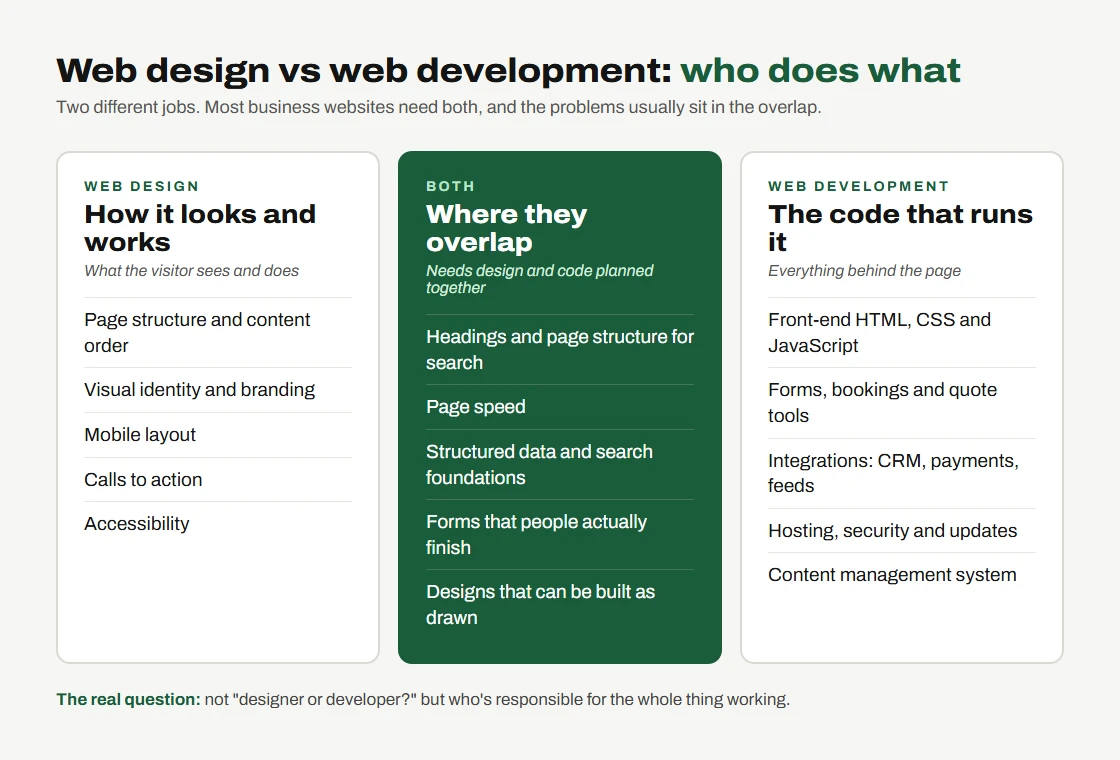
Web design is how a website looks and how it works for the person using it. Web development is the code that makes it run. Design covers layout, branding, navigation and what a visitor sees on a phone. Development covers building those pages and the forms, bookings and integrations behind them, then keeping the whole thing fast and secure. For most business websites the real question isn't which one you need. It's whether one team handles both or you're paying two people to pass work back and forth.
What web design covers
Design gets decided before anyone writes code, and it's all about the visitor.
- Structure: which pages exist, what goes on each one and the order a visitor reads them in.
- Visual identity: type, colour, spacing and imagery that look like your business and nobody else's.
- Mobile layout: how every page reads on a phone, which is where most visitors land first.
- Calls to action: where the phone number, quote button or booking link sits and how obvious it is.
- Accessibility: contrast, text size and layouts that everyone can actually use.
A designer usually hands over mockups or a clickable prototype. It shows exactly how the site should look and behave. It doesn't run yet.
What web development covers
Development turns that design into a working site and handles everything a visitor never sees.
- Front end: the HTML, CSS and JavaScript that draw each page in the browser.
- Back end: forms, quote tools, booking systems and anything that stores or sends data.
- Integrations: your CRM, email, payments, calendar, inventory or listings feed.
- Performance: how fast pages load, especially on a phone connection.
- Security and hosting: spam protection, updates, backups and a server that stays up.
- Search foundations: clean markup, structured data, a sitemap and pages search engines can actually read.
A developer hands over a site that works. Whether it looks right depends on the design it was built from.
When you mostly need design
Some projects really are design-led. If the features you need are standard and already solved, the work is mostly about how the site looks and reads.
- You're on Shopify, Squarespace or a similar platform that already handles hosting and checkout, and the site just looks dated.
- You've rebranded and the site needs to match.
- People visit but don't call or enquire, which usually points to structure and calls to action rather than code.
Even here there's development involved. Someone still has to build the new layout properly, and a theme stretched past what it was made for gets slow quickly.
When you mostly need development
Other projects are development-led. The site can look fine and still be the problem.
- You need something a template doesn't do: an instant quote, a booking flow, a client portal or a live listings feed.
- Pages are slow, forms fail without telling anyone or the site breaks on certain phones.
- The site looks finished but barely shows up in search.
That last one catches people out. We've seen a site that looked polished and complete send Google an error on every page except the homepage, because it was built as a single-page app with nothing a crawler could read. The design was fine. The people searching for that business just never got to see it.
Why it's usually both
Most businesses asking this question need a site that looks credible, works on a phone, turns visitors into calls and can be found. That's design and development together, and the trouble tends to live in the gap between them.
Designs that can't be built as drawn
A mockup can show anything. If it was drawn without knowing how it'll be built, the developer either quietly compromises it or builds something heavy and slow to match it.
Search lives on both sides
Headings, page structure and answer-first copy are design decisions. Speed, markup and structured data are development decisions. If either side treats SEO as someone else's job, it doesn't get done. The same goes for getting named in AI answers, which runs on the same foundations.
Nobody owns the handoff
With two vendors, a slow page is a design problem to the developer and a development problem to the designer. You end up managing two invoices and a disagreement.
The useful question isn't "designer or developer?" It's "who's responsible for the whole thing working?" If the answer is two different people, know which one gets the call when something breaks.
Five questions to ask before you hire
Whatever someone calls themselves, these will tell you what you're actually getting.
1. "Who writes the code, and can I see a live site you built?"
Open it on your phone. If it's slow or awkward there, yours probably will be too.
2. "What happens if I need a feature later, like online booking?"
You want to hear how it would be added, not that you'd need a new site.
3. "Is SEO part of the build or an add-on?"
Search foundations are cheapest when they're built in from day one. Retrofitting them later means reworking pages that are already live.
4. "Do I own the site and the domain when it's done?"
You should, and it should be in writing.
5. "Who looks after it after launch?"
Updates, security and hosting don't stop on launch day. Know who handles them and what that costs before you sign.
If the answers keep pointing at other people, you're buying one piece of a website. That can work, as long as you know who's building the rest. It's also worth asking whether the company tracks how you show up in AI search, since that's quickly becoming part of what "found" means.
Where we sit
We do both. Every site we build is designed and developed by the same team, with the search work built in from the start instead of sold back to you later. After launch, we keep looking after it, so there's never a gap between the people who made the site and the people who keep it working.