Someone types "best finish carpenter in Edmonton" into ChatGPT. It comes back with three names and a short reason for each. There's no page two, no map pack, no ten blue links to scroll. You're either one of the three or you don't exist.
That's the change. It isn't coming, it already happened, and most businesses have no idea whether they're in those answers or not. This is the practical version of how to find out and what to do about it.
First, understand how AI picks who to name
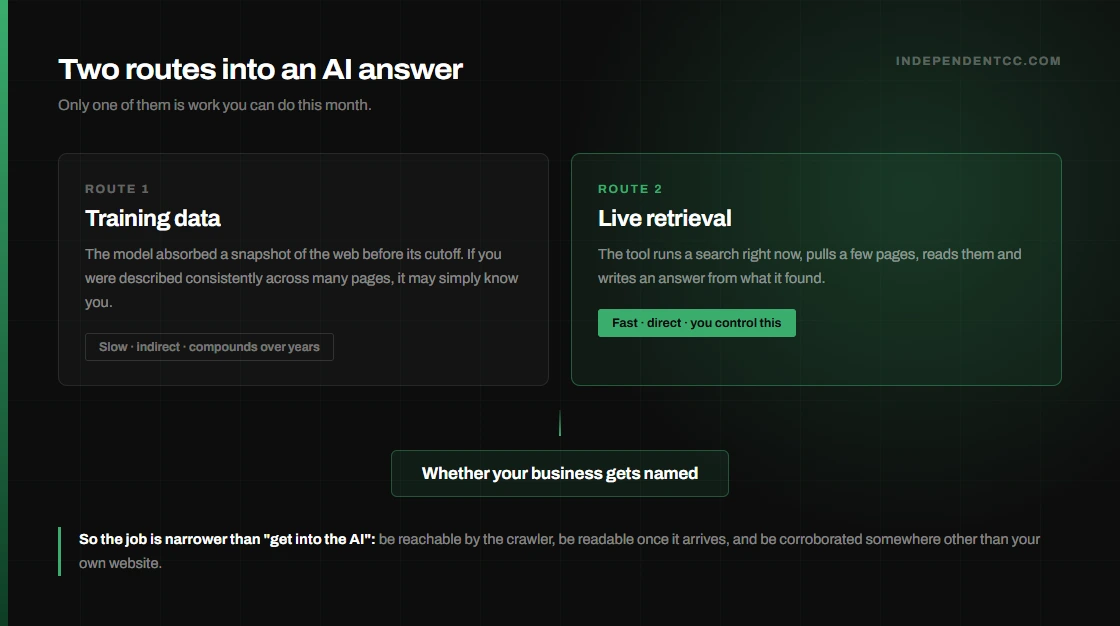
AI tools name businesses through two different routes, and they need different work from you.
Route one is training data. The model absorbed a snapshot of the web at some point in the past. If your business was described consistently across a lot of pages before that cutoff, the model may just know you. You can't optimize for this directly and you certainly can't do it quickly. It's the slow compounding one.
Route two is live retrieval, and this is the one you can actually influence. When you ask ChatGPT, Perplexity or Google something local or current, the tool runs a search behind the scenes, pulls a handful of pages, reads them, and writes an answer from what it found. That happens in real time, against the live web, today.
This is the single most useful thing to understand: for most local and commercial questions, AI isn't reciting memory. It's running a search, reading a few pages and summarizing them. So the work that gets you retrieved and quoted is mostly work you can do this month.
Which means your job is narrower than "somehow get into the AI." It's this: be findable by the crawler, be readable once it arrives, and be corroborated somewhere other than your own website.
1. Let the AI crawlers in
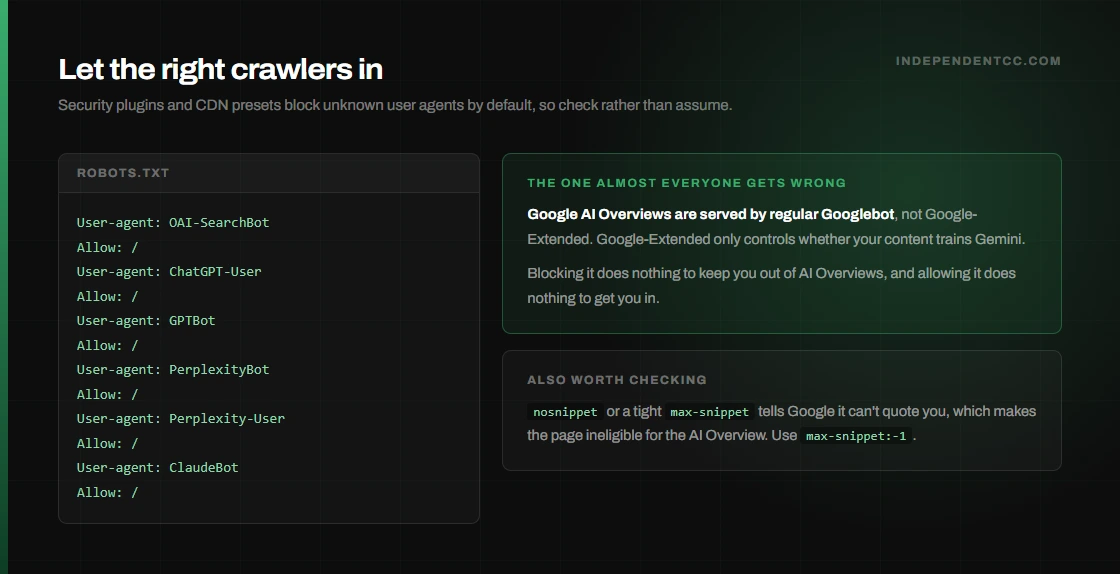
You'd be surprised how many sites quietly block the exact bots they need. Some security plugins and CDN presets block unknown user agents by default. Check your robots.txt and make sure these are allowed:
- OAI-SearchBot: the one that surfaces sites in ChatGPT's search results. Block this and you're out of ChatGPT search answers. Allow it first if you allow nothing else.
- ChatGPT-User: fires when a person or a Custom GPT asks ChatGPT to go and fetch a page. OpenAI notes it's user-triggered rather than a bulk crawler, so it isn't governed by robots.txt the way the others are, but listing it costs nothing and keeps your intent explicit.
- GPTBot: OpenAI's training crawler. Allowing it feeds the slow route.
- PerplexityBot and Perplexity-User: Perplexity cites sources heavily, so it's often the easiest early win.
- ClaudeBot: Anthropic's crawler.
- Googlebot: obvious, but see the warning below.
Here's the part almost everyone gets wrong. Google AI Overviews are served by regular Googlebot, not by Google-Extended. Google-Extended only controls whether your content trains Gemini. Blocking it does nothing to keep you out of AI Overviews, and allowing it does nothing to get you in. If someone told you to block Google-Extended to "protect your content," understand that you gave up training presence and got no control over AI Overviews in return.
One more, and it follows from the same logic. Google's position is that robots.txt for Googlebot governs crawling for Search, and that nosnippet, data-nosnippet, max-snippet and noindex are how you limit what it may show from your pages. Those preview controls aren't scoped to the old blue-link snippet, so restricting them restricts what an AI feature can surface from you as well. Unless you have a specific reason to hold content back, max-snippet:-1 is the setting you want.
2. Answer the question in plain visible text
An AI reading your page is looking for a passage it can lift and attribute. That passage has to be self-contained. If the answer to "how much does a deck cost in Alberta" only emerges after reading four paragraphs of throat-clearing about your company values, there's nothing to quote.
The pattern that works is boring and effective:
- Put the real question in a heading, worded the way a person would ask it.
- Answer it directly in the first sentence or two underneath.
- Then add the nuance, the caveats and the detail.
That's it. Question as a heading, answer immediately below, elaboration after. It reads well for humans too, which is why it survives every algorithm change.
Put your FAQs in real headings
A depressing number of sites wrap FAQ questions in a styled div because it was easier to design that way. To a crawler that's just text in a box. Use h2 or h3 for questions and pair the visible list with FAQPage structured data, with the schema matching the visible text word for word. Mismatched schema is worse than none, because it looks like manipulation.
3. Be the same business everywhere
AI tools resolve you to an entity before deciding whether to name you. If your business name, address and phone number differ across your website, your Google Business Profile and a handful of directories, you look like several vaguely similar businesses rather than one confident answer.
Pick one canonical form of your name, address and phone number. Use it identically everywhere. Add Organization schema with a sameAs array pointing at your profiles. If you have a Google Knowledge Graph entry, reference it. This is unglamorous housekeeping and it moves the needle more than most content work.
4. Get corroborated off your own site
This is the one people skip, and it's the one that decides most close calls.
An AI summarizing "who should I hire for X in Y" is weighing consensus. Your own website claiming you're the best is worth almost nothing on its own. What it wants is agreement across sources it didn't get from you: reviews, directory listings, an industry association page, a supplier's contractor list, a local news mention, a Reddit thread where someone recommends you by name.
Practical version, roughly in order of effort:
- Google Business Profile filled out completely, with real reviews. Reviews get read and quoted.
- The obvious directories for your trade and your region, with consistent details.
- Any association, certification or supplier page that will list you.
- Genuine participation in places where your customers ask questions. Not spam, actual answers.
5. Structured data, then llms.txt
Schema markup won't get you cited on its own, but it removes ambiguity about what you are, where you work and what you sell. At minimum: Organization, Service for each thing you offer, FAQPage where you have questions, and BreadcrumbList. Validate it. Broken JSON-LD is silently ignored.
Then add an llms.txt file at your root. It's a plain-language summary of what your site covers and where the important pages are, written for machines. Adoption is still early and it isn't a magic switch, but it costs an hour and it makes your site easier to summarize correctly.
What doesn't work
Worth saying plainly, because there's a lot of noise:
- Keyword stuffing. These are language models. Repetition reads as low quality to them the same way it does to you.
- Thin pages at scale. Forty near-identical city pages was a mediocre tactic for Google and it's a worse one here, because a summarizer has nothing distinct to summarize.
- Content that only exists after JavaScript runs. Some AI crawlers don't execute JS at all. If your key text isn't in the HTML source, assume it isn't there.
- Hidden text aimed at AI. People are trying prompt injection in white-on-white text. It gets stripped, and when it doesn't, it gets you distrusted.
Actually test it
You can't manage what you don't measure, and no rank tracker covers this properly yet. So do it manually, and write the results down.
- List the ten questions a good customer would actually ask before hiring you. Real phrasing, not keywords.
- Ask each one in ChatGPT, Perplexity and Google, in a logged-out or private window so your own history doesn't flatter the result.
- Record who gets named, in what order, and what the tool says about them.
- Repeat monthly. You're looking for movement, not a single snapshot.
That last point matters more than it sounds. AI answers vary between runs, so one good result proves nothing and one bad result isn't a crisis. The trend over a few months is the real signal.
The honest timeline
The crawler and schema fixes can land in a week and sometimes show up quickly, especially in Perplexity. Entity consistency takes a few weeks to propagate. Genuine third-party corroboration is a months-long job because it depends on other people, and it's also the most durable advantage, for exactly that reason.
None of this replaces SEO. A site that's technically broken, slow or unindexed won't get cited by anything, because the same crawl has to succeed first. This is SEO extended to cover a second set of destinations, which is why we run both as one program rather than selling them separately.