Total Search Optimization (TSO) is a single program that covers both traditional search engines and AI answer engines. It combines conventional SEO with the work needed to get a business named inside answers from ChatGPT, Perplexity, Gemini and Google's AI Overviews. Where SEO alone targets ranking, TSO treats ranking and getting cited as one visibility problem, because customers now use both and don't think of them as different.
That's the definition. The rest of this explains why the term exists and answers the obvious objection.
The three acronyms it covers
The industry produced three overlapping terms in about eighteen months. Briefly:
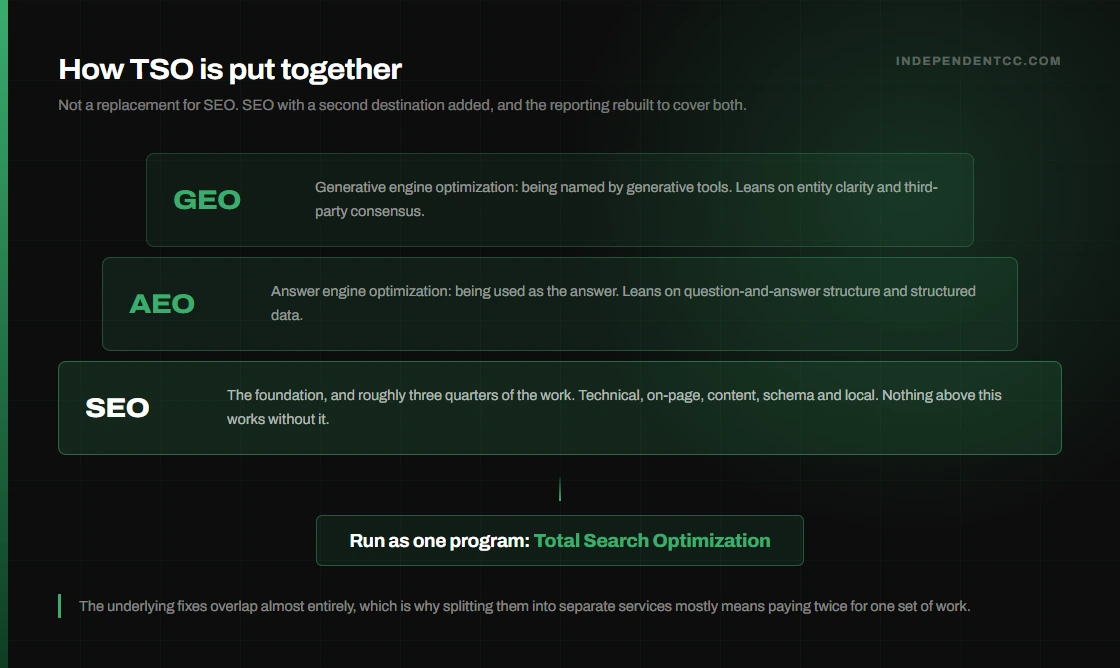
- SEO, search engine optimization. Getting a page to rank in a conventional results list. Technical health, on-page structure, content, links, local signals.
- AEO, answer engine optimization. Getting your business used as the answer, whether that's a featured snippet, a voice assistant reply or an AI summary. Leans on clear question-and-answer structure and structured data.
- GEO, generative engine optimization. Getting named specifically by generative tools. Depends heavily on entity clarity and on third-party corroboration, because a model weighs consensus across sources rather than your own claims.
TSO is our name for doing all three as one job, because in practice they aren't three jobs.
Why the term exists
Not because the world needed another acronym. Because splitting them creates a real practical problem.
The underlying fixes overlap almost entirely. Fixing your site architecture helps ranking and it helps a crawler read you. Clean structured data helps rich results and it helps a model understand what you are. Consistent business details across the web help local ranking and they help a model decide you're one business rather than three. Genuine third-party mentions help authority and they help consensus.
So when these get sold as separate services, you usually pay twice for one set of work, and you get two reports that don't reconcile. Running them as one program is mostly an honesty measure.
What's actually in it
The bulk of the work is conventional SEO, and we'd rather say that plainly than pretend otherwise:
- Technical: crawl, indexing, speed, site architecture, schema markup.
- On-page: titles, headings, content structure, internal linking.
- Content: the questions customers actually ask, answered directly.
- Local: Google Business Profile, citations, consistent name, address and phone number.
- Reporting: what moved, what's next, monthly.
The additional layer specific to answer engines:
- AI crawler access, checked deliberately rather than assumed.
- Answer-shaped content: real questions in real headings, answered immediately below, with matching FAQ structured data.
- Entity consistency across your site, your profiles and the wider web, so you resolve to one business.
- Off-site corroboration, because a model weighs what other sources say about you far more than what you say about yourself.
- Tracking whether the major AI tools name you for real customer questions, over time.
Is this just SEO with a new name?
Fair question, and the honest answer is: partly, yes.
Perhaps three quarters of the work is what a competent SEO provider has always done. If your current provider does that well, they've built most of the foundation already and none of it is wasted, because a site that can't be crawled or indexed can't be cited by an AI either.
What's genuinely different is the destination and therefore the measurement. Optimizing to be quoted by a summarizer is not identical to optimizing to rank in a list. The formatting priorities differ, entity clarity matters far more, off-site consensus matters far more, and success looks like being named in prose rather than holding a position number. If nobody is measuring that second destination, nobody is managing it.
Put simply: TSO isn't a replacement for SEO and it isn't a competing methodology. It's SEO with a second destination added and the reporting rebuilt to cover both. We gave it a name because "SEO plus the answer engine work, measured together" is a mouthful in a proposal.
Who it's for
It's worth it if customers research before they buy, if you're in a considered purchase rather than an impulse one, and if being one of three names in an answer would meaningfully change your year. That covers most trades, professional services and specialist retail.
It's less urgent if you're almost entirely referral-driven and happy with that, or if your category genuinely isn't being asked about in these tools yet. We'd rather tell you that than sell you a program you don't need, and checking takes about ten minutes.